
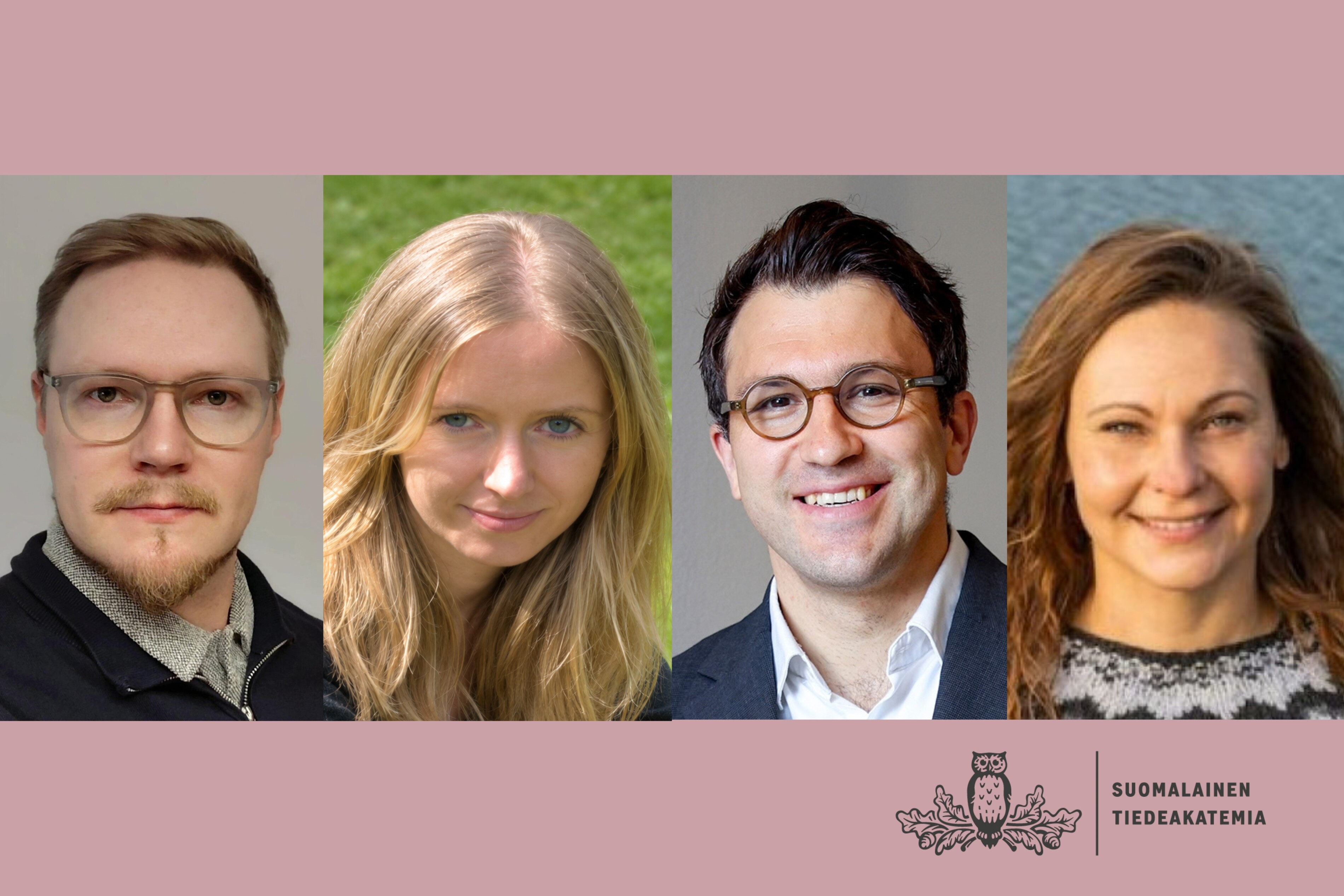


The three-year, 200,000 euro Väisälä project grants, awarded by the Academy of Sciences, have been granted to Antti Moilanen, Saija Saarni, Mirka Saarela, and Anton Zasedatelev. The grants will fund research into tiny light sources, known as nanolasers, sediment layers at the bottom of lakes, the development of artificial intelligence, and quantum mechanical behavior.
This year, the number of grants awarded has been increased from two to four, and the grant amount has been raised from 150,000 euros to 200,000 euros. The Academy of Science awards project grants from the Väisälä Fund to researchers in the fields of physics, mathematics, geophysics, astronomy, and meteorology who are in the early stages of establishing a permanent research career.
Funding for Four Different Projects
Antti Moilanen, an assistant professor at the University of Eastern Finland, is researching extremely small light sources—nanolasers—based on materials that are incredibly thin, just one atomic layer thick. The goal of the research is to develop even smaller lasers that operate directly on electricity without a separate auxiliary laser.
The research grant will enable the development of new device research devices and experimental research that combines nanotechnology, materials physics, and optics. The research has potential applications, for example, in telecommunications as well as in future computers and sensors based on optical circuits, which require small and energy-efficient light sources.
A study by Saija Saarni, an assistant professor at the University of Turku, examines how changes in the climate or environment are reflected over time in the mud, or sediment, that accumulates at the bottom of a lake. By studying sediment layers, it is possible to determine how a lake was like in the past and to better understand the complex relationship between climate and sedimentation, as well as the response of a lake under changing conditions, such as sudden extreme events.
This research provides essential additional information on the baseline conditions of lakes and critical turning points for the purposes of water body protection and restoration.
Mirka Saarela, an assistant professor at the University of Jyväskylä, is researching how artificial intelligence can be developed into a technology that is as reliable and fair as possible through the use of mathematics. There has been a huge leap forward in the use of artificial intelligence across various fields, which is why it is increasingly essential that it operates fairly, transparently, reliably, and securely.
This funding will enable the development of new mathematical models, the study of trade-offs between competing AI objectives, and the validation of results through mathematical research. The methods being developed can help AI developers and decision-makers understand and address the challenges associated with AI development and their potential consequences.
The research of Anton Zasedatelev, an assistant professor at Aalto University, focuses on quantum mechanical behavior in macroscopic systems, such as particles on the nanometer and micrometer scale, whose motion can be isolated, measured, and controlled with extreme precision. By levitating these particles in an ultra-high vacuum, it is possible to study how large objects behave as they are brought closer to the quantum realm, where fundamental noise and quantum physics phenomena begin to have a significant impact.
Potential applications of this research include a new generation of ultra-precise measuring instruments capable of measuring gravity, acceleration, rotational motion, pressure, and electric and magnetic fields. The long-term goal is to extend quantum-level control to ever larger and more massive systems and to utilize them as highly sensitive measuring instruments for detecting weak forces.
The next call for applications for Väisälä project grants will open in January 2027. Starting next year, the Finnish Academy of Science and Letters will award a total of nearly 5 million euros annually in grants and prizes to Finnish science. The majority of the grants are awarded to young researchers.